

2026.03.19/21/22
Hosts
School of Intermedia Art
School of Sculpture & Public Art
Organizers
Institute of Contemporary Art and Social Thoughts
K+project
Discussants
Zheng Shengtian, Chen Aikang, Lu Jie, Tang Xiaolin, Zhang Zhongtao, Jiang Feiran
Workshop Researchers
Yang Yize, Song Yao, Huang Jiaying
Workshop Introduction
The Past and Present of the Contemporary
The Subjective Realm in Art
Zheng Shengtian's artistic career encompasses multiple "firsts": In 1981, as the first person officially sponsored by the Ministry of Culture for an exchange in the US after the Reform and Opening-up, he studied at the University of Minnesota for two years; in 1987, he assisted in organizing North America's first Chinese contemporary art exhibition, Beyond the Open Door: Contemporary Paintings from the People's Republic of China (USC Pacific Asia Museum); in 1989, he helped establish Shanghai's first contemporary art gallery—the Shanghai Theatre Academy Gallery; in 1990, he founded the bilingual magazine Art China Newsletter; in 1998, he was the first to bring a Chinese contemporary art gallery to Art Basel; in 2000, as the Art Director of the Annie Wong Art Foundation, he facilitated the historic visit of the Documenta 11 curatorial team to China; in 2002, he co-founded the world's first English journal introducing contemporary Chinese art, Yishu: Journal of Contemporary Chinese Art; he successively participated in the preparatory work for Art Asia in Hong Kong and the first China Art Expo in Guangzhou, and was involved in curating and promoting the early development of the Shanghai Biennale... From the New Era to the new century, from the domestic to the international stage, Zheng Shengtian has always been present throughout a series of critical junctures, major events, and core scenes in the history of Chinese art.
This workshop series invites scholar, artist, and curator Mr. Zheng Shengtian—a driving force and witness deeply involved in the process of Chinese contemporary art—to lead us in revisiting three important clues and moments for understanding "China/Contemporary/Art" through three thematic dialogues with a new generation of faculty and students:
Session 1: In the Unfinished Movement of the New Wave Art
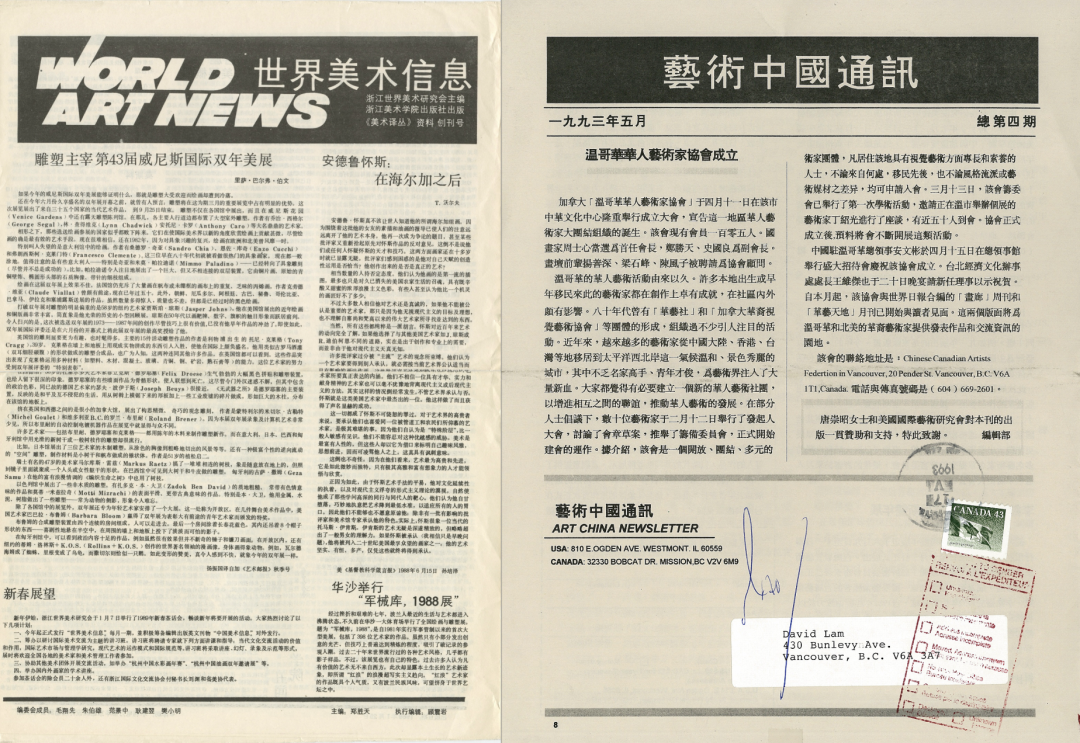
Image caption: World Art Information, inaugural issue, page 1, January 1989; Art China Newsletter, Issue 4, page 8, May 1993
The magnificent "New Wave" seen in the rearview mirror truly relied on the "incremental actions" of people at that time. As a participant and promoter of the "85 New Wave," and even as a teacher and defender of some core artists, Zheng Shengtian was not only situated at the core scene of the art movement but also continuously expanded cross-cultural networks through his vision, driving the emergence of new art. This session chooses two publications founded by Zheng Shengtian, World Art Information and Art China Newsletter, as a starting point. It traces back to the origins of the New Wave and looks forward to the publication of Yishu, exploring the incremental projects in an era of limited information, which forms a sharp contrast and reference to today's era of information overload.
Session 2: The Curators’ Delegation Visit to China in 2000
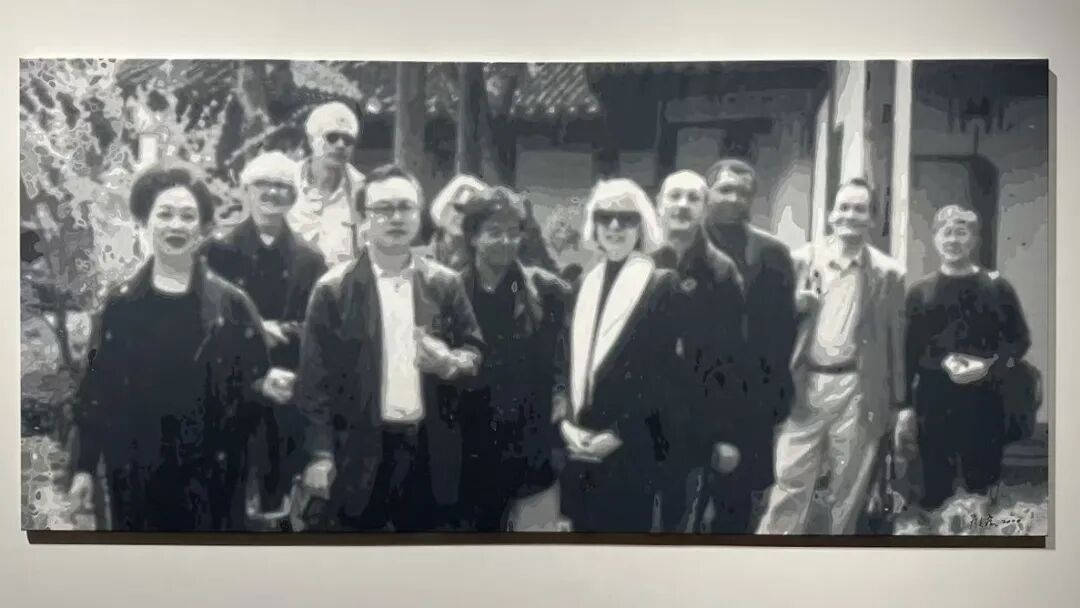
Image caption: The Curators, Yan Lei, acrylic on canvas, 2000. From left to right: Annie Wong, Susanne Ghez, Chris Dercon, Ken Lum, Jessica Bradley, Sarat Maharaj, Lynne Cooke, Sebastián López, Okwui Enwezor, Zheng Shengtian, Yao Shouyi
In 2000, supported by the Annie Wong Art Foundation and organized and accompanied by Zheng Shengtian (then Secretary-General of the foundation), Okwui Enwezor, the artistic director of Documenta 11, along with a delegation of seven curators and artists including Lynne Cooke, Chris Dercon, Susanne Ghez, Sarat Maharaj, Ken Lum, Jessica Bradley, and Sebastián López, visited six cities—Hangzhou, Shanghai, Beijing, Guangzhou, Taipei, and Hong Kong—within fifteen days. The itinerary included artist studio visits, institutional tours, symposiums, and public lectures, and sparked intense debates at the China Academy of Art in Hangzhou... Revisiting this historic juncture today helps us clarify the origins and development of ourselves and the corresponding "international" context.
Session 3: Mexico, A Lingering Dream
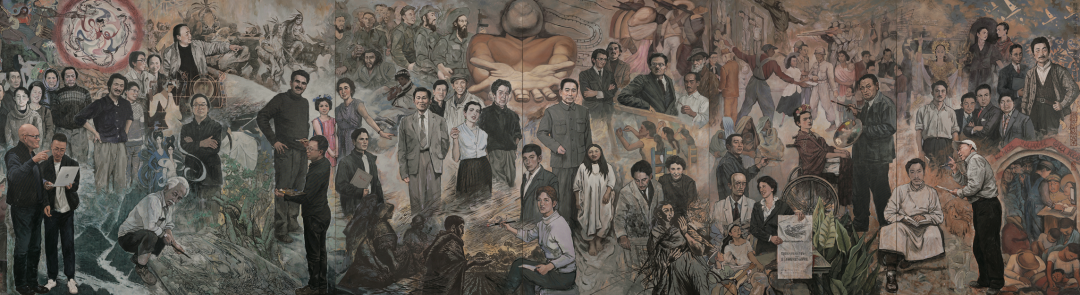
Image caption: Winds from Fusang, Zheng Shengtian, Sun Jingbo, Dong Zhuo, Ma Xin, acrylic on canvas, 320 × 1200 cm, 2017
In 2017, the exhibition Winds from Fusang and its eponymous masterpiece were presented. This painting and its curatorial action are not merely a continuation of Zheng Shengtian's "Mexican Dream" spanning over half a century, but also a profound retrieval of history. It connects Lu Xun's introduction of Diego Rivera in the 1930s, the Sino-Mexican artistic dialogues in the 1950s, and the airport mural movement in the late 1970s, bringing the historical propositions of "Socialist Modernism" and "Internationalism" back into the present. The starting point of all this stems from the 1956 exhibition of the Mexican Front of Plastic Arts in China and the arrival of artists like David Alfaro Siqueiros. The seed planted in the heart of the young Zheng Shengtian took root and sprouted through the years, transforming into a "Mexican complex" that has permeated almost his entire life.
Zheng Shengtian's artistic life practice acts as a prism, reflecting the energies buried deep in the folds of 20th-century art history, from which we can question the meaning, value, and ideals of art in cross-historical and cross-cultural contexts. We also expect that through the presence of this vivid history of an artistic life, we can guide the younger generation to establish an autonomous system of historical perception, to understand the past and present of the "contemporary," and the "subjective realm" of art, ultimately producing a precious academic record and accumulating new literature for future research and reflection.
Discussants Introduction
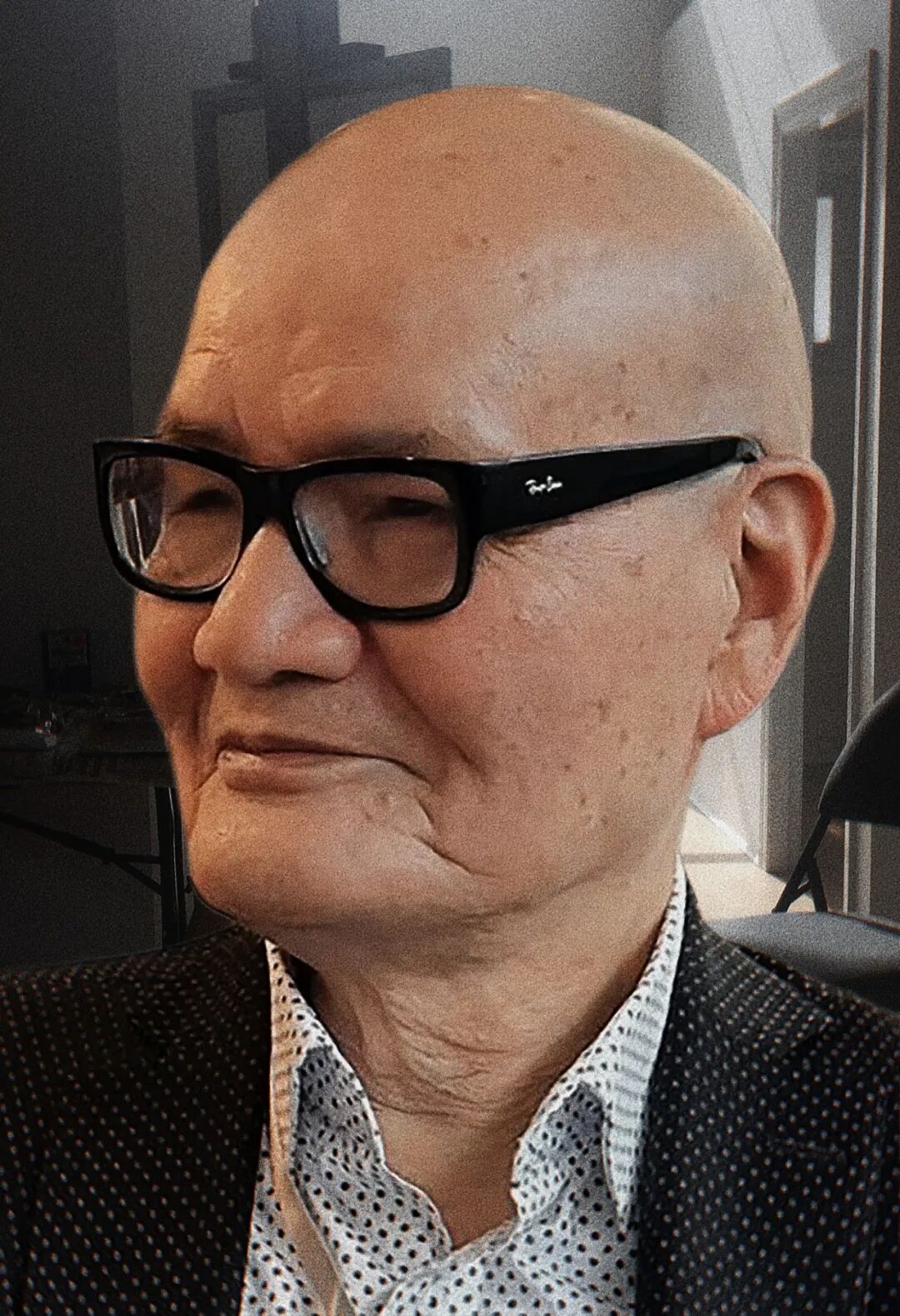
Zheng Shengtian is an artist, scholar, and curator based in Vancouver. Before 1990, he worked at the China Academy of Art as Professor and Chair of the Oil Painting Department. He was a visiting professor at the University of Minnesota and San Diego State University, Secretary of the Annie Wong Art Foundation, Founding Board Director of Vancouver International Centre for contemporary Asian Art, and the Adjunct Director of the Institute of Asian Art at the Vancouver Art Gallery. Currently, he is the Managing Editor of Yishu: Journal of Contemporary Chinese Art, a trustee of Asia Art Archive in America and a Research Fellow at Simon Fraser University. Zheng has organized and curated numerous exhibitions and events, and has frequently contributed to periodicals and catalogues. In 2013, Zheng Shengtian: Selected Writing on Art was published in four volumes by China Academy Press. In 2011. His latest publications include Sino-Mexican Art and Cultural Exchanges in the Twentieth Century (Cambria Press, 2024) and a Chinese version. He was awarded the Lifetime Achievement Award for curatorial work by the Vancouver Biennale. In 2013 He received an Honorary Doctorate of Letters from Emily Carr University of Art + Design.
Hosts
School of Intermedia Art
School of Sculpture & Public Art
Organizers
Institute of Contemporary Art and Social Thoughts
K+project
Discussants
Zheng Shengtian, Chen Aikang, Lu Jie, Tang Xiaolin, Zhang Zhongtao, Jiang Feiran
Workshop Researchers
Yang Yize, Song Yao, Huang Jiaying
Workshop Introduction
The Past and Present of the Contemporary
The Subjective Realm in Art
Zheng Shengtian's artistic career encompasses multiple "firsts": In 1981, as the first person officially sponsored by the Ministry of Culture for an exchange in the US after the Reform and Opening-up, he studied at the University of Minnesota for two years; in 1987, he assisted in organizing North America's first Chinese contemporary art exhibition, Beyond the Open Door: Contemporary Paintings from the People's Republic of China (USC Pacific Asia Museum); in 1989, he helped establish Shanghai's first contemporary art gallery—the Shanghai Theatre Academy Gallery; in 1990, he founded the bilingual magazine Art China Newsletter; in 1998, he was the first to bring a Chinese contemporary art gallery to Art Basel; in 2000, as the Art Director of the Annie Wong Art Foundation, he facilitated the historic visit of the Documenta 11 curatorial team to China; in 2002, he co-founded the world's first English journal introducing contemporary Chinese art, Yishu: Journal of Contemporary Chinese Art; he successively participated in the preparatory work for Art Asia in Hong Kong and the first China Art Expo in Guangzhou, and was involved in curating and promoting the early development of the Shanghai Biennale... From the New Era to the new century, from the domestic to the international stage, Zheng Shengtian has always been present throughout a series of critical junctures, major events, and core scenes in the history of Chinese art.
This workshop series invites scholar, artist, and curator Mr. Zheng Shengtian—a driving force and witness deeply involved in the process of Chinese contemporary art—to lead us in revisiting three important clues and moments for understanding "China/Contemporary/Art" through three thematic dialogues with a new generation of faculty and students:
Session 1: In the Unfinished Movement of the New Wave Art
Image caption: World Art Information, inaugural issue, page 1, January 1989; Art China Newsletter, Issue 4, page 8, May 1993
The magnificent "New Wave" seen in the rearview mirror truly relied on the "incremental actions" of people at that time. As a participant and promoter of the "85 New Wave," and even as a teacher and defender of some core artists, Zheng Shengtian was not only situated at the core scene of the art movement but also continuously expanded cross-cultural networks through his vision, driving the emergence of new art. This session chooses two publications founded by Zheng Shengtian, World Art Information and Art China Newsletter, as a starting point. It traces back to the origins of the New Wave and looks forward to the publication of Yishu, exploring the incremental projects in an era of limited information, which forms a sharp contrast and reference to today's era of information overload.
Session 2: The Curators’ Delegation Visit to China in 2000
Image caption: The Curators, Yan Lei, acrylic on canvas, 2000. From left to right: Annie Wong, Susanne Ghez, Chris Dercon, Ken Lum, Jessica Bradley, Sarat Maharaj, Lynne Cooke, Sebastián López, Okwui Enwezor, Zheng Shengtian, Yao Shouyi
In 2000, supported by the Annie Wong Art Foundation and organized and accompanied by Zheng Shengtian (then Secretary-General of the foundation), Okwui Enwezor, the artistic director of Documenta 11, along with a delegation of seven curators and artists including Lynne Cooke, Chris Dercon, Susanne Ghez, Sarat Maharaj, Ken Lum, Jessica Bradley, and Sebastián López, visited six cities—Hangzhou, Shanghai, Beijing, Guangzhou, Taipei, and Hong Kong—within fifteen days. The itinerary included artist studio visits, institutional tours, symposiums, and public lectures, and sparked intense debates at the China Academy of Art in Hangzhou... Revisiting this historic juncture today helps us clarify the origins and development of ourselves and the corresponding "international" context.
Session 3: Mexico, A Lingering Dream
Image caption: Winds from Fusang, Zheng Shengtian, Sun Jingbo, Dong Zhuo, Ma Xin, acrylic on canvas, 320 × 1200 cm, 2017
In 2017, the exhibition Winds from Fusang and its eponymous masterpiece were presented. This painting and its curatorial action are not merely a continuation of Zheng Shengtian's "Mexican Dream" spanning over half a century, but also a profound retrieval of history. It connects Lu Xun's introduction of Diego Rivera in the 1930s, the Sino-Mexican artistic dialogues in the 1950s, and the airport mural movement in the late 1970s, bringing the historical propositions of "Socialist Modernism" and "Internationalism" back into the present. The starting point of all this stems from the 1956 exhibition of the Mexican Front of Plastic Arts in China and the arrival of artists like David Alfaro Siqueiros. The seed planted in the heart of the young Zheng Shengtian took root and sprouted through the years, transforming into a "Mexican complex" that has permeated almost his entire life.
Zheng Shengtian's artistic life practice acts as a prism, reflecting the energies buried deep in the folds of 20th-century art history, from which we can question the meaning, value, and ideals of art in cross-historical and cross-cultural contexts. We also expect that through the presence of this vivid history of an artistic life, we can guide the younger generation to establish an autonomous system of historical perception, to understand the past and present of the "contemporary," and the "subjective realm" of art, ultimately producing a precious academic record and accumulating new literature for future research and reflection.
Discussants Introduction
Zheng Shengtian is an artist, scholar, and curator based in Vancouver. Before 1990, he worked at the China Academy of Art as Professor and Chair of the Oil Painting Department. He was a visiting professor at the University of Minnesota and San Diego State University, Secretary of the Annie Wong Art Foundation, Founding Board Director of Vancouver International Centre for contemporary Asian Art, and the Adjunct Director of the Institute of Asian Art at the Vancouver Art Gallery. Currently, he is the Managing Editor of Yishu: Journal of Contemporary Chinese Art, a trustee of Asia Art Archive in America and a Research Fellow at Simon Fraser University. Zheng has organized and curated numerous exhibitions and events, and has frequently contributed to periodicals and catalogues. In 2013, Zheng Shengtian: Selected Writing on Art was published in four volumes by China Academy Press. In 2011. His latest publications include Sino-Mexican Art and Cultural Exchanges in the Twentieth Century (Cambria Press, 2024) and a Chinese version. He was awarded the Lifetime Achievement Award for curatorial work by the Vancouver Biennale. In 2013 He received an Honorary Doctorate of Letters from Emily Carr University of Art + Design.